



December: Holidays and Traditions
For the HR directors and workforce planners at rural Indiana hospitals who are tired of losing staff and missing out on candidates they should be winning.
Standard Recruiting is Falling Short
If you lead HR or operations at a rural Indiana hospital, you already know staffing is a daily struggle. You see it in the roles that sit vacant for months. You feel it through the dedicated staff covering extra shifts until they simply can't anymore. And you live with the quiet reality of competing for talent against urban health systems with resources that often feel out of reach.
Here's what's frustrating: the advice you keep getting wasn't built for you.
Standard recruiting frameworks were designed for urban markets. When you apply them to rural Indiana, you're not just using the wrong tool. You're actively working against yourself. RepuCare spent 2024 and 2025 conducting a statewide job market analysis specifically focused on rural and remote Indiana populations to understand why this keeps happening and, more importantly, what actually works.
Here's what the data revealed
The Numbers Are Worse Than Most People Admit
The staffing crisis in rural Indiana isn't a perception problem. The numbers confirm what you already know and make the stakes impossible to ignore.
-
50% of rural hospitals are operating at a financial loss, the largest single-year increase researchers have ever recorded (AMA Council on Medical Service, 2025)
-
25% of rural Indiana hospitals have scaled back or cut essential clinical services due to acute staffing and budget shortfalls (Bowen Center for Health Workforce Research, 2024)
-
35 Indiana counties have no birthing hospital, making local maternity care increasingly out of reach for rural women (Indiana Rural Health Association, 2025)
-
52.4% of U.S. rural hospitals no longer offer obstetric care, up from 43.1% in 2010, and Indiana reflects this national trend (JAMA, January 2025)
-
Rural areas have two-thirds fewer behavioral health professionals than urban areas, with some Indiana counties having virtually none (Indiana Rural Health Association, 2025)
-
50% of Indiana counties are classified as ambulance deserts, where EMS response times exceed 25 minutes, putting an estimated 100,000 Indiana residents at risk (Indiana Rural Health Association, 2025)
Many Indiana rural counties are also federally designated Primary Care Health Professional Shortage Areas (HPSAs), meaning they don't have enough primary care providers to meet minimum federal standards of adequate care.
These aren't staffing inconveniences. They are structural failures with direct consequences for patient outcomes.
Why Standard Recruiting Keeps Failing Rural Organizations
Most healthcare recruiting was built for urban markets. The frameworks, the compensation benchmarks, the sourcing strategies: all of it was designed with a very different candidate and a very different community in mind.
The core problem is this: Indiana is not one labor market.
Northwest Indiana competes in the Chicago corridor. Central Indiana competes with Indianapolis health systems. Rural Southern and Eastern Indiana have their own dynamics entirely. Organizations that apply a single statewide pay band simultaneously overpay in some markets and lose candidates in others, often without realizing it.
But compensation is only part of the equation. The candidates who thrive in rural settings aren't motivated the same way urban candidates are. The people who will stay in Jasper or Tipton or Vincennes are often driven by something more. A connection to community, a sense of mission, a genuine understanding of what rural patients actually need. Most recruiting approaches never engage those drivers at all.
Three Truths That Shape Successful Rural Talent Strategies
RepuCare's statewide research, covering labor and demographic variables, compensation structures, turnover rates, and retention patterns across five regions, points to three foundational truths that separate organizations that solve this problem from those that keep repeating it.
1. Compensation alone does not explain why people stay or leave. Social determinants of health, sense of mission, and community connection are retention drivers just as powerful as salary and far more durable. Chasing turnover with counteroffers misses the root cause entirely.
2. Rural Indiana is not one market. Geography, regional economy, and local culture each shape what candidates need to hear before they say yes. A hiring strategy that works in one region will actively fail in another. Regional market intelligence isn't a nice-to-have. It's table stakes.
3. Leading organizations engage rural talent differently. They source based on community need, individual passion, and a genuine desire to serve populations that the broader healthcare system often overlooks. This isn't idealism. It's a more effective selection strategy.

What Actually Keeps Rural Workers in Their Roles
Filling a role and keeping a person are two very different problems. RepuCare's research identified six retention factors that consistently drive long-term rural workforce stability:
-
Mission Alignment: Workers recruited around purpose and community impact stay longer. When the "why" of rural healthcare is communicated clearly, it resonates.
-
Adequate Staffing Levels: Chronic understaffing is self-reinforcing. Burnout drives turnover, and turnover drives burnout. Breaking the cycle requires a strategy, not just a hire.
-
Community Connection: Candidates sourced for genuine connection to rural populations consistently outperform those placed purely on credentials.
-
Regional Compensation: Base pay needs to be benchmarked at the regional level, not against a statewide average. Workers know what their neighbors are making.
-
Stability and Transparency: Workers leave when they sense financial fragility. How leadership communicates during uncertainty matters as much as the financial reality itself.
-
Career Pathway Visibility: Rural workers stay when they can see a future inside your organization without having to leave the community.
The Bottom Line
Rural Indiana's healthcare staffing challenges are not a temporary disruption. They are structural imbalances driven by geography, shrinking talent pools, and narrow margins that have been building for decades. Because rural providers operate with the fewest tools to combat this instability, they absorb the greatest impact.
The organizations that are winning are not doing so by outspending urban systems. They're winning by understanding their market, engaging the right candidates in the right way, and building retention strategies that address what rural workers actually value.
The data exists. The strategies are proven. The gap is in execution.

Get the Full Data
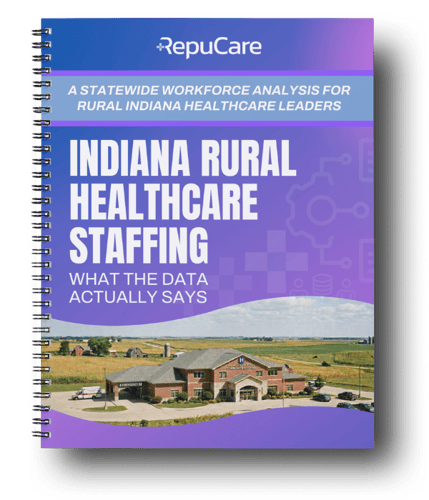
RepuCare's complete statewide workforce analysis, Indiana Rural Healthcare Staffing: What the Data Actually Says, goes deeper on compensation benchmarks by region, attrition patterns, and actionable strategies for rural talent acquisition and retention.

Or if you're ready to talk through what the regional market looks like for your specific roles, schedule a complimentary Indiana market consultation with a RepuCare workforce specialist.
We'll walk you through current compensation benchmarks for your region and identify exactly how to strengthen your hiring strategy.
Schedule a Meeting Today → www.RepuCare.com/get-started
RepuCare is an Indiana-based healthcare workforce solutions firm with over 30 years of experience specializing in the recruitment, placement, and retention of clinical and operational professionals across the state. We connect people with purpose so organizations can thrive.